
《Nature Nanotechnology》硼纳米簇实现室温再氢化,推动 LiBH₄迈向高容量可逆储氢
氢能规模化应用的核心瓶颈在于安全、高效、低成本的储运技术。复杂金属硼氢化物中,LiBH4 具有高达18.5 wt.% H2 的理论储氢容量和121 kg H2 m-3的体积储氢密度,被视为极具潜力的高容量固态储氢载体。然而,LiBH4 脱氢后生成的 B 和 LiH 对 H2 分子反应活性极低,使硼氢化物再生长期依赖高温高压等苛刻条件,严重限制了其可逆储氢应用。
针对这一难题,浙江大学、复旦大学等团队在Nature Nanotechnology发表研究,首次从硼纳米簇表面活性位点出发,揭示了H2必须先解离为H原子、并在低配位Bspike位点形成B-H键的关键机制。在此基础上,研究团队构筑了约10 nm LiBH4纳米颗粒与约3 nm Ni催化簇耦合的nano-LiBH4@30Ni复合体系,使脱氢产物B/LiH在30°C、100 bar H2条件下即可重新氢化,为高容量硼基储氢材料的低温可逆再生提供了新的思路。
LiBH4的难点不在“容量”,而在“再生”
LiBH4的储氢容量优势十分突出,但真正限制其应用的并不是单次脱氢,而是脱氢后B/LiH难以重新氢化回LiBH4。传统LiBH4通常需要超过400℃才能脱氢,而从LiH + B重新生成LiBH4往往需要600°C、350 bar H2等极端条件。这项工作的核心突破在于:解释了B为什么难以氢化、怎样才能重新形成B-H键。
● 理论计算表明,H2分子难以直接与B团簇有效反应;B-H键形成的前提是H2先解离成原子H。
● B团簇表面的低配位、突出的Bspike原子是H原子吸附和B-H键形成的主要活性位点。
● B团簇尺寸越小,Bspike原子比例越高;将B缩小至超细纳米尺度,是提升B/LiH再氢化活性的关键。
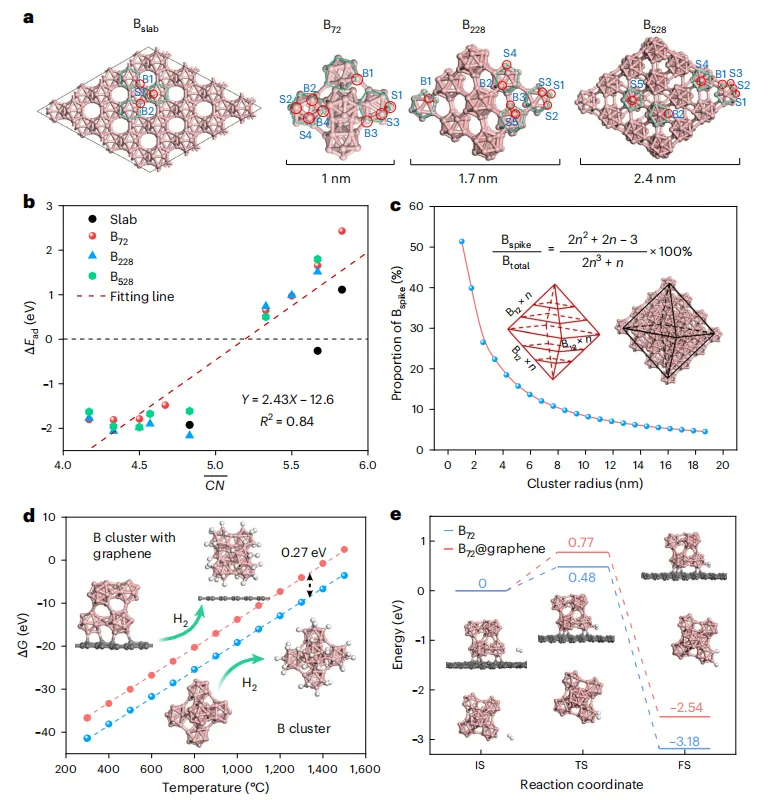 Figure 1. Theoretical calculations reveal Bspike active sites and the size-dependent hydrogenation reactivity of boron clusters
从30°C氢化到高容量循环
基于上述认识,作者设计了nano-LiBH4@30Ni层级纳米结构:约10 nm LiBH4初级颗粒由约3 nm Ni催化簇修饰,并组装成100-150 nm二级球形颗粒。脱氢后,体系形成5-10 nm尺度紧密接触的B/LiH/Ni纳米结构,为后续低温再氢化提供了空间基础。
一、近室温吸氢:30°C下启动B/LiH向LiBH4再生
● 在100 bar 氢压下,Ni修饰B/LiH纳米复合物的氢化起始温度低至30°C;相比无Ni的nano-B/LiH和bulk-B/LiH,分别降低约170°C和295°C.
● 30°C、100 bar氢压下材料可吸收约1.7 wt.% H2;50°C、120 bar 氢压下吸氢量提升至约3.3 wt.% H2。
● 当温度提升至200°C和250°C时,在100 bar氢压条件下吸氢量分别达到约7.9 wt.%和9.0 wt.% H2,显示出较高可逆容量潜力。

Figure 4. Hydrogenation of the dehydrogenated nano-LiBH4@30Ni under different temperatures and hydrogen pressures.
二、低温脱氢与循环:脱氢速率和可逆容量同步改善
● nano-LiBH4@30Ni的起始脱氢温度约为120°C,脱氢峰温约为286°C,明显低于原始LiBH4和无Ni的nano-LiBH4。
● 在300°C等温脱氢条件下,该材料60 min内可释放约9 wt.% H2;原始LiBH4在相同条件下释放量低于0.4 wt.% H2。
● 平均脱氢速率较原始LiBH4提升43.5倍;经过20次循环后仍保持约8.2 wt.%的可逆氢容量。
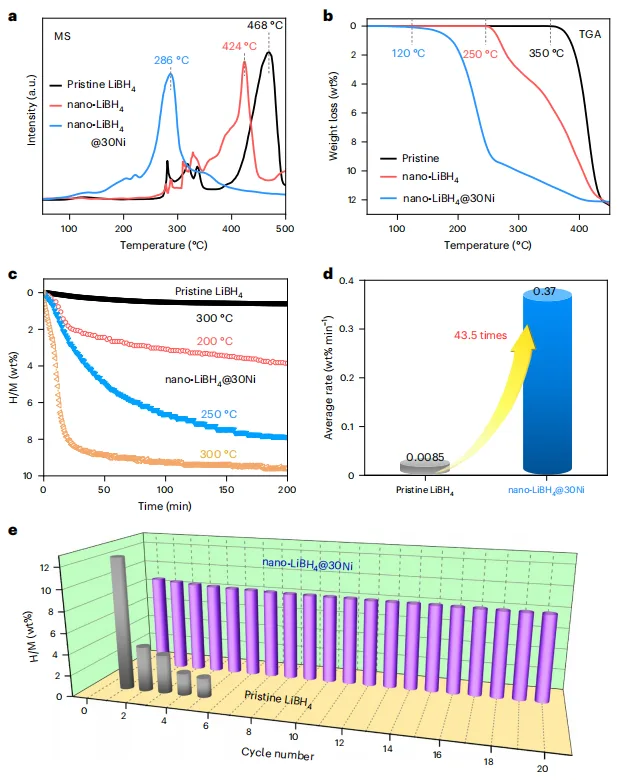 Figure 6. Dehydrogenation performance and cycling stability of the nano-LiBH4@30Ni composite
机制:Bspike活性位点+Ni簇H2解离+氢溢流
这项工作的机制逻辑可以概括为三句话:B本身难以直接吸附H2;Ni纳米簇负责把H2解离为活性H原子;超细B/LiH纳米结构提供足够多低配位Bspike位点,使H原子可以逐步形成B-H键并最终再生LiBH4。
三、Ni纳米簇调控B/LiH氢化反应路径
● DFT计算显示,3 nm级Ni簇中的Ni t2g轨道可与H2的反键σ*轨道有效杂化,促进电子从Ni向H2转移,从而削弱H-H键。
● 在Ni簇作用下,H-H键长由0.751 Å增至0.949 Å,说明H2被显著活化,更容易解离为H原子。
● Ni簇还会与B簇形成Ni-B异质界面,界面电荷积累和轨道杂化可削弱B-B键,使B更容易发生氢化。
● NMR结果显示,氢化过程中依次出现Li2B5H5、Li2B7H7、Li2B3H8等中间相,最终生成LiBH4;这说明再氢化是由表面向内部推进的多步过程。
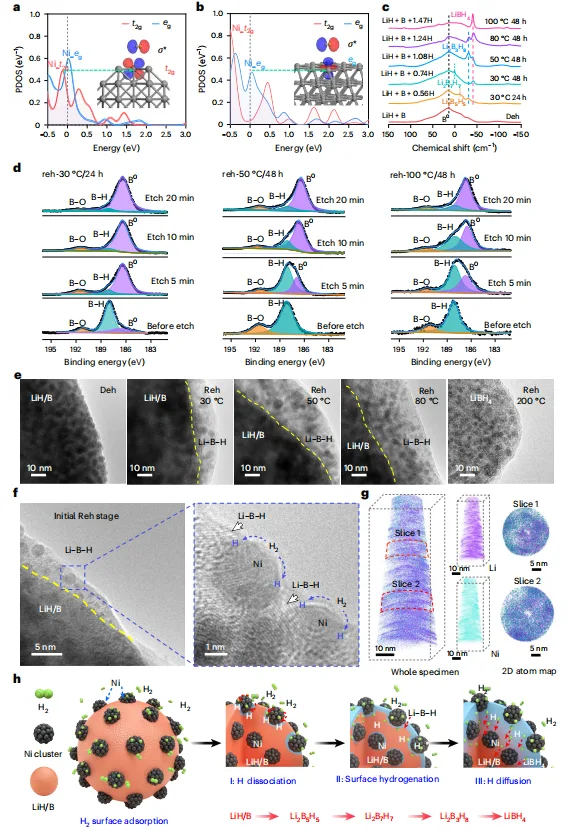 Figure 5. Hydrogenation mechanism of nano-LiBH4@30Ni: Ni-catalysed H2 dissociation, surface hydrogenation and H diffusion
国仪量子H-Sorb 4600PCT Pro高压储氢吸附仪
高压储氢吸附仪可以实现材料在不同温度及不同高压环境下对氢气的吸脱氢行为检测,可有效表征材料吸脱氢温度和压力、吸脱氢量、吸脱氢速率等储氢材料吸脱氢热/动力学关键性能。

产品特点:
● 测试数据稳定复现,LaNi5吸附量重复精度高达±1%
● 钴合金高压气动阀门支持5万次以上超长吸脱附循环测试
● 任意项目(PCT、Kinetics、Cycle、TPA/TPD)全自动连续组合测试
● 极速温压控制,结合自动连用功能综合测试效率提升40%
● 可定制20g-1000g级宏量测试系统、原位XRD及质谱联用系统
● 可定制70MPa或100MPa超高压测试系统
● AI科研助手,数据问题智能解答、测试性能辅助分析
● 全自动吸脱附变温测试(PCT、Kinetics、Cycle)
● 全自动连续多温度测试(PCT、Kinetics)
近期助力成果目录
1.Solvent-mediated partial ionicity enhances mechanical nanosizing effect of Mg-based hydrogen storage alloys. Nature Communications (2026)
2.Room-Temperature Alane Dehydrogenation for Visible-Light-Driven Photocatalytic Hydrogen Supply System. Advanced Science (2025)
3.Dual‐Stage Heat Treatment for Enhanced Hydrogen Storage Properties of Mg-N-Y Alloys. Rare Metals (2026)
4. A novel carbon-induced-porosity mechanism for improved cycling stability of magnesium hydride. Journal of Magnesium and Alloys (2025)
5.Impacts of Y addition on the hydrogen storage performance of Ti-Zr-Mn-Cr-Fe alloys. Journal of Alloys and Compounds (2026)
6. Effect of Ni doping on hydrogen storage kinetics and thermodynamic properties of ball-milled Nd-Mg alloy. Journal of Alloys and Compounds (2025)
7. Superior de/hydriding kinetics and cycling stability of Mg-CeAl3@CeH2 nanocomposites. Journal of Alloys and Compounds (2025)
8.Doping-induced enhanced hydrogenation resistance and structural stability in SmCo5 permanent magnets: A combined theoretical and experimental study. Journal of Alloys and Compounds (2026)
9. Breaking kinetic and thermodynamic barriers: CeO2-Ni-rGO synergistic catalysis for comprehensively enhanced hydrogen storage performance of MgH2. Journal of Alloys and Compounds (2026)
10.Structural and Phase Evolution in the Mg-Al System Leading to Lower Hydrogen Desorption Temperature. Hydrogen (2025)
11.Interpretable machine learning framework for hydrogen storage capacity prediction in Ti-Zr-Mn-Cr-V high-entropy alloys: Influenced by valence electron average. Journal of Energy Storage (2026)
12.Dual-strategy regulation for enhancing hydrogen storage performance of non-activated Mg8Ni-TiO2/MnO2 composites. Journal of Energy Chemistry (2025)
13.Nanoscale effect of spontaneous combustion of sulfur corrosion products: Oxygen adsorption and activation mechanism dominated by mesopores. Fuel (2026)
14.Pore structure reconfiguration and microscale fluid response in bituminous coal under CO2 and flue gas-enhanced coalbed methane recovery. Fuel (2026)
15. Experimental and theoretical investigation on hydrogen storage performance of titanium decorated hexagonal boron nitride. Applied Surface Science (2026)
16.Cu-based methanol steam reforming catalyst supported by heat conduction enhanced GO+UiO-66 composite MOF material for long-term stable hydrogen production. International Journal of Hydrogen Energy (2025)
